Aaron Baltaytis — Testicular Cancer Survivor
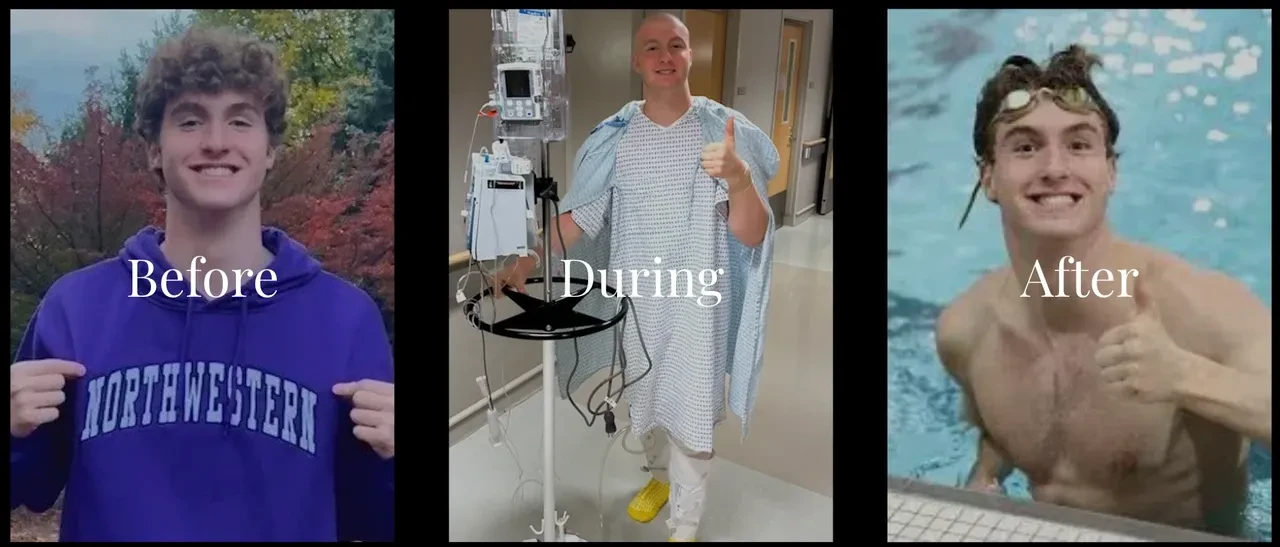
At 18, Aaron Baltaytis was diagnosed with metastatic testicular cancer — 27 tumors, four rounds of chemo, and a nine-hour surgery at Memorial Sloan Kettering. Today he is in remission, back on the Northwestern swim team, and using his story to bring hope to others.
Before Cancer
I was born on October 12, 2005, in Tenafly, New Jersey, a small suburb of New York City where I've lived my whole life. I'm the youngest of three children—my brother Jacob is a financial consultant in New York City, my sister Kira just started law school at Boston University, and our family's "favorite" is Cody, our Wheaten Terrier. My parents immigrated from the former Soviet Union to build a better life, and I've always carried their sacrifices with me.
From a young age, I was inspired by my brother to swim competitively. Swimming quickly became my passion and shaped most of my life. At 10, I won my first state championship, and by 12 I held a #1 national ranking in my age group. By high school, I was one of the top swimmers in the Northeast and the #42 recruit in the country. I committed to Northwestern University to study Economics while continuing my swimming career. As a freshman, I became a three-time Big Ten B-finalist, earned CSCAA Scholastic All-American Honorable Mention, and was named a Big Ten Distinguished Scholar. Then, in May 2024, everything changed.
Cancer Diagnosis and Treatment Journey
On May 8, 2024, I was diagnosed with metastatic testicular cancer. The following day, scans revealed 27 metastatic tumors in the lymph nodes of my retroperitoneum.
My treatment began quickly. On May 11, 2024, I had an orchiectomy to remove the primary tumor. Recovery was minimal—I left the hospital the same day. Soon after, I started chemotherapy with Etoposide and Cisplatin (EP), the standard regimen for testicular cancer. Each cycle lasted three weeks (five treatment days and sixteen days of rest). I completed four cycles between May 27 and August 18, 2024, with Neulasta Onpro support to protect my white blood cell counts.
Although chemo reduced much of the disease, 27 tumors remained that were chemo-resistant. On August 28, 2024, I underwent a nine-hour surgery at Memorial Sloan Kettering (MSKCC) —Retroperitoneal Lymph Node Dissection (RPLND)—to remove them. The recovery was intense, requiring a week in the hospital, but it successfully removed all the tumors.
Current State, Reflections, and Outlook
Today, I am in remission. I undergo scans every four months to monitor for recurrence. I am proud to say I've returned to competition and am once again a full member of the Northwestern swim team.
Cancer changed my life in ways I couldn't have imagined. Overnight, news outlets began sharing my story, and I found myself being asked to speak and inspire others. More importantly, cancer made me mature beyond my years. Daily frustrations and small problems that once seemed important now feel insignificant compared to what I've faced.
This journey also brought me closer to God. Prayer had always been a part of my life, but my diagnosis gave it new meaning. On the first day home after hearing the news, I asked my mom for a Star of David necklace. I've worn it every day since as a reminder of faith and the bigger plan at work.
I now see advocacy as part of my purpose. I talk with other testicular cancer patients being treated at MSKCC, share my story with news outlets, and recently became a spokesperson for the HEADstrong Foundation. This organization, founded by athletes for athletes, provides housing and financial support for families facing cancer. Being able to use my platform to give hope to others is one of the greatest honors of my life.
At 19 years old, I've already learned how fragile and precious life is. Cancer may have interrupted my path, but it hasn't taken away my dreams. I'm swimming again, studying at Northwestern, and living each day with faith, gratitude, and a determination to use my story to bring hope to others.
Charting My Cancer Journey
What follows is my personal journey through cancer—the highs, the lows, and the mental battles in between.
In each section, I'll open up about what I experienced and how I learned to move from difficult emotions like fear, anxiety, and despair toward courage, peace, and hope.
If you're walking this road too, I hope these moments help you see that you're not alone—and that shifting your mindset can become a powerful part of your healing.
Shock to Acceptance
Can you take us back to the moment you heard the diagnosis? What did that shock feel like, and what helped you start moving toward acceptance?
Believe it or not, I wasn't really shocked at my initial diagnosis. It came the day after an ultrasound, and when the doctor asked me to come in the next morning, I knew things weren't good. The main shock was when I got a CT scan and reviewed it with my doctor -- seeing the amount of cancerous mass in my body was quite frightening. This definitely was a difficult time emotionally as I had no idea that things could get this bad without showing any signs of symptoms.
What helped me move into a place of acceptance was understanding that having a mindset of shock or disbelief wasn't going to help me get through this process. I knew that I had to be in a good mental state to get through this battle, this started right at the beginning.
This time of initial shock came after my primary tumor was already surgically removed, so I was still recovering from it. This kept me from doing the things I really loved like staying active by playing sports. However, I did everything I could to keep my mind off what was to come. That meant keeping up to date with my school work, looking for a job, but also having some down time playing video games and watching TV.
My support system was what got me through these initial hardships. My parents were freaking out even more than I was, making it a little bit more challenging to stay calm. However, they got me in contact with the best cancer doctors in the world and drove me to every appointment. The doctors were always reassuring, but direct with what our plan was going to be. My friends were the light of this journey. They assured me that I was going to be okay and they kept me distracted from what was to come. They made me laugh and smile and not feel like a cancer patient about to go through a challenging battle.
To someone experiencing a moment of shock, I would say to ground yourself. What do you do on an everyday basis when something doesn't go your way? Is it an activity? Do you talk to someone? etc. This shock, cancer, even though it is on a much larger scale, is no differently wired in your brain than our everyday challenges. So do what you would normally do to ground and calm yourself from shock. Staying as grounded as possible is integral in accepting this battle.
Fear to Courage
What fears began to surface after your diagnosis, and what helped you take your first steps toward courage despite them?
There were two main moments of fear during my journey. The first was when I first met my surgeon and he was going over potential outcomes of my surgery, one of which was death. Being 18 years old and thinking you were going to die is extremely scary. Hearing his words definitely made my heart skip a beat and raised my blood pressure. The next event was seeing my first CAT scan after my first round of chemotherapy. The tumors had not shrunk at all, enforcing my fear that I was going to die.
What mainly helped me move from the intensity of fear to a place of courage was time. A lot of things were happening all at the same time, my diagnosis, surgery, chemotherapy, etc., and it was all super overwhelming. However, as time slowly began to pass and I went through treatment after treatment, I realized that I could get through this.
The practice that provided me relief and clarity during these times was just continuing to do the things that I loved, while also finding new outlets. As a collegiate swimmer, I wanted to stay near the sport of swimming. So I decided to coach my local club team. Seeing kids everyday loving the sport and working hard, just as I do, inspired me to be courageous so I can return to swimming after this journey is over. Furthermore, I picked up new hobbies like golf and pickle ball to keep myself active without putting too much stress on my body. These brought mental clarity that was needed rather than staying at home alone with my fearful thoughts.
Everyone around me was all in on helping me through these challenging times. My parents drove me to every doctor's appointment. My sibling came home from work and spent time with me every day. My head swim coach would text me every morning asking how I was doing. My friends would FaceTime whenever they had free time. Their parents would send me gift baskets filled with all of the things that I loved. My medical staff was always positive, yet objectively truthful, when they were talking to me. Having all of this support around me made it possible to get through this challenge.
Fear is normal. Cancer is not something you are ever expecting to have. However, you can't let fear cloud your judgement or make you have a negative outlook on life and this journey. The best way to get through this is to stay positive. You can do it!!
Depression to Joy
During moments when you felt weighed down or overwhelmed, what did that season of depression look like—and what helped you begin finding joy again?
One event that caused a feeling of depression was when I lost all of my hair. I was just about to go to my cousin's birthday dinner with all of my family. I went to take a shower and all of my hair started falling out. As a teenage boy, I took a lot of pride in my hair. Looking in the mirror and seeing a bald head was definitely not something on my bucket list. I knew it would happen eventually, but I still wasn't ready for it. Furthermore, as a Division 1 swimmer, I always took pride and joy in my strength and exercise. One day during my second round of chemo, I was having trouble picking up a cup of tea without having my whole arm shake. This was extremely depressing because I hadn't noticed too many physiological changes up until that moment.
What helped me move from my depression to a happier state of joy is the understanding that this pain and misfortune is only temporary and that I will get through this. Additionally, instead of asking myself and asking God, "why me?" with a negative mindset, I understood that I was picked to withstand this struggle to provide others with further good. Knowing that I could bring good to this world brought me much joy.
Something that provided me a lot of clarity during these times was my dog. Not only because he always wanted to cuddle with me when I wasn't feeling well, but because he actually taught me something. No matter what happened during the day, his tail was always wagging, he was always running to the door when someone came in, he always wanted to play. He showed me that no matter what was happening, he lived everyday to the fullest and enjoyed every second of life.
During the two main moments of depression, my dad was the one who was best there for me. When I first lost all of my hair, he rubbed my head and said, "new haircut?" His little joking tease with me made me laugh — best medicine many say. In the second scenario he sat me down and said something along the lines of, "I know this is hard, it's gonna suck, but you have to get through this." Knowing the reality of the situation, and that he had my back through this, was much needed to bring me out of my depressive state.
I would reiterate that life is a blessing. Even in our hardest days, it is better to be alive than dead. Also, I was given the advice of trying to find joy in the little things in life, a dog's tail wagging, a stranger's smile, or even a tree turning warm colors in the fall. These little bits of joy add up quickly and go a long way.
Anxiety to Calm
When anxiety began to take hold, what thoughts or situations triggered it—and what helped you find moments of calm in the midst of it?
The moments when I felt anxiety were very similar to when I felt stress. This typically occurred while I was waiting at the doctors office or when I was getting ready for a scan. My mind would race -- I didn't know what the doctor would say. I went into every appointment wondering whether I was going through another round of chemo or I was going to get a surgery. I sat there like a sitting duck and just waited for the doctor's blessing. For the scans, I would be in my gown, biting my nails, wondering what the results would hold in store for my future. I felt like this because each prior scan had not shown any signs of shrinkage.
What mainly helped move me from anxiety to a state of calm was self-talk, talking to those around me (both of which was mainly saying "everything is going to be okay"), and keeping myself preoccupied with other activities.
The activities, like I have been saying for other chapters, were anything that I loved to do to keep my mind off the worst possible case scenario. I would try to stay active to get my endorphins out, I would play with my dog, and spend time with my family and friends. There were no specific resources or practices that I did otherwise to change my anxiety into calmness.
Everyone around me just continued to tell me that everything was going to be okay -- that I'll make it through this and I'll be back to doing the things that I love with the people that I love. Hearing it over and over again from others really made me believe that it was possible.
The advice that I would give to someone experiencing this in their cancer journey is that everyone around you wants to help. Every single person on this Earth has been touched by cancer in one way or another, themselves, a family member, a friend, and they all know about how difficult treatment, recover, and everything in between is, so don't be afraid to reach out and talk to people -- tell them how you are struggling and you will be amazed at the support that you receive.
Loss to Fulfillment
What did you feel you lost through your cancer journey—and how did you begin to rediscover a sense of purpose or fulfillment?
I had two main moments of physical loss throughout my journey with cancer. These were arguably the two most difficult moments, completely outweighing the feeling of stress, anger, anxiety, or any other emotion. The first was when I had lost my testicle. Losing something that is so intimate is definitely difficult emotionally and physically. Not only was the surgery painful, but being different than everyone else is a serious emotional burden. Next, was during my main surgery when I lost the ability to ejaculate. While this didn't cause any pain, knowing that I could never naturally produce my own child was extremely challenging for me.
What helped me move from my state of loss to a state of fulfillment was the joys of life. I came to learn that living life healthy is so much more important than having both testicles or the ability to ejaculate semen. I learned that living life was the biggest blessing -- more than any ability or body part.
The only thing that provided relief during this time was time itself. These losses were very mentally taxing on me that only became easier with time.
Everyone was there for me as they had been the entire journey, but these losses were something that I had to deal with myself. The medical staff provided a lot of support by informing me beforehand so I wasn't in shock, but the heavy lifting was all done by myself.
The advice that I would offer to someone experiencing this would be that everyone's journey is different. No matter what loss you have, you have to find fulfillment in the life that cancer has given you. You have to find joy and fulfillment in the little things in life, otherwise this will be a long and painful process.
Anger to Gratitude
Did you experience anger during your journey—toward your situation, others, or even God—and what helped you begin shifting toward gratitude?
There were two main moments of anger during my journey. The first was at the end of my first of four rounds of chemo. If there was no sign of shrinkage then I would proceed immediately with surgery and potentially be done with my cancer journey. However, there was a tiny sign of shrinkage, meaning I had to endure three more rounds. This also occurred when I first started feeling the effects of chemo so I was especially angry. The second instance was right after my 9-hour-long surgery. I had a catheter placed that was very uncomfortable and frequently fell out. I couldn't get out of bed by myself, I couldn't shower -- I had never dealt with anything like this. It was more frustrating than painful.
The realization that this was part of the process to make me healthy brought me into a state of gratitude. Moreover, the realization that I could help others going through the same thing brought me the most gratitude. I knew that I could act as a light for others that were struggling if I behave myself and act like cancer has nothing on me.
My family was everything during these challenging moments. Nobody else, friends or medical staff, really saw me during my moments of anger, except for my family. Even through it all, they were patient with me and knew that I wasn't actually angry at them, but at the entire cancer situation as a whole. No matter if I raised my voice, or acted poorly, they remained themselves and continued to take care of me.
Every person who is battling cancer is dealt a very unfortunate hand. However, each person can act as a light and an inspiration for others, those dealing with something similar, or even those that are perfectly healthy. People often think, "oh, he/she has cancer" and that automatically makes you weak. But, if you show strength during this type of hardship, one that everyone is familiar with, either directly or indirectly, it can go a long way.
Helplessness to Empowerment
When you felt most out of control or helpless, what was that experience like—and what helped you begin to regain a sense of strength and empowerment?
I think there was only one situation in which I felt helpless. I had just met with my urologist for the first time and he explained to me the process that I am going to have to go through, i.e. chemo and surgeries. It mainly occurred when he was explaining the potential side effects of my surgery: kidney loss, infertility, and even death. I realized that there was nothing that I could do. This was very difficult for me emotionally because my health, and my fate, was not in my own hands and that was scary.
The main realization that helped me move to a state of empowerment was that I was in the best possible hands. I was working with one of the best urologists in the world, especially for testicular cancer, and he worked very closely with my oncologist. Additionally, I was working with top tier chemo nurses and everyone was there just to ensure my health.
The main practice that I did was just to go on walks. Just to get your thoughts out, breathe in fresh air, and enjoy your surroundings really goes a long way. Furthermore, the exercise contrasts very well with the chemo ward of a hospital.
My family would simply remind me that I was in the best possible hands for what I had. My medical staff provided all of the medical treatment that I needed: all that I could possibly ask them to do.
To someone experiencing helplessness in their cancer journey I would tell them this: You are not alone. Everyone who has heard these diagnoses has felt helpless at some point or another, but you are never alone. Lean on those around you, and more importantly, trust the medical experts who have spent so long trying to get to a position where they can help you.
Loneliness to Loved
Were there moments when you felt alone in your journey—and what helped you begin to feel seen, supported, and truly loved?
I thankfully never felt lonely in terms of not having people around me -- my friends and family always made sure of it. However, I did feel lonely in terms of not being understood by the healthy people around me and left out of activities due to being immunocompromised or fresh out of surgery. There was no specific instance of this, but rather it stayed a feeling throughout most of my treatment. I felt different than those around me: not swimming, not having an internship, not being able to do the normal day-to-day of a teenager. This didn't affect me physically, but at times it was emotionally draining. The FOMO made me feel like college days and time for enjoyment were just flying by.
What helped me move from loneliness to a state of feeling loved was simply coming to the understanding that this is how my life is for now. I have this bump in the road standing between my current life and what is to come. I knew that it wasn't permanent and my time to live regularly will return.
The main resource that I used was the internet. I looked on various threads and saw that many people have experienced what I was enduring and returned to lead a fulfilling life afterwards. It provided me lots of hope and clarity, even though I didn't necessarily know these people.
The people around me were everything during this process. I was never alone when I didn't want to be. Those around me time and time again made consistent efforts to come see me and make sure I wasn't alone.
Personally, I would try to find others in, or have experienced, a similar situation. There is no better way of curing loneliness than speaking with someone who has experienced it themselves. Furthermore, I encourage everyone to do the same afterwards to pay it forward.
Despair to Hope
Were there moments when you felt deep despair—and what helped you begin to find hope again, even if just a small glimpse at first?
I think that the main moments of despair came during the recovery of my second surgery - many of which even after I was pronounced cancer-free. The first moment of despair that I could think of was waking up in my hospital bed the morning after surgery, seeing a foot-long cut down my stomach, having numbness in my quads, and barely being able to move. I wondered if I would even be myself again. Another key event that triggered feelings of despair was when I first started doing physical therapy, six weeks after my surgery. I was asked to hold a plank for as long as I could, and my body started shaking immediately -- I could barely hold myself up. Although the despair came from physical trauma, it more so affected me emotionally. I really struggled with the doubt that I could ever be the same athlete that I once was.
What helped me move from my despair to a feeling of hope was patience. Slowly, brick by brick, I stayed patient with myself and saw myself recover into the person I used to be. One step on the hospital floor, and one added pound per exercise, I eventually believed that I could be the same old me.
The main thing that provided relief during these times was keeping track of my progress. By seeing numerical progression in how far I could walk, how many pounds I can lift without pain, and eventually back to how fast I could swim, I would see each step in my recovery journey as just a number instead of feelings of despair that came with thinking I will never be good enough again.
My friends were extremely key in this process. Most of my recovery process took place when I was at college, so they were the ones closest to me. They had faith in me even when I didn't have faith in myself and that meant the world. They picked me up when I fell down and never left me behind.
The advice that I would offer to someone experiencing these types of feelings is document your feelings and whatever you can and never lose hope for your outcome! Beating cancer is not something easy to do, and it gets a whole lot harder if you don't have faith or patience.
Guilt to Self-Acceptance
Did you experience any feelings of guilt during your journey—and what helped you begin to release that and move toward self-acceptance?
I felt both burden guilt and survivors guilt. I questioned why it was me who was able to get through this, while so many others are not so lucky. This was very challenging emotionally and it is often triggered when I am speaking to someone currently battling cancer. I also feel like there were many times when I was a burden to those around me, especially my parents who were my main caregivers, and supported me financially. This is because my bills added up very quickly with all of my scans, surgery, etc.
What helped me move from a state of guilt to a feeling of self-acceptance was the belief that I could help others. I can serve as a light for those suffering and give motivation to others enduring hardship. This made me feel like I survived for a good reason.
What provided relief during these times were so many people giving me opportunities to share my story and help others, whether it is being in this book, on podcasts, or even on TV. Giving me these types of opportunities furthered my belief that I could give inspiration to others.
My parents were really the best. They always did everything asked and needed without a single complaint. They never let me say sorry. They did everything they could to get me back and assured me that this was for the better.
I would say to someone experiencing guilt, especially survivors guilt, is to make the most of their lives to help others. This way your survival is for a reason.
Explore Topics
Written by
Aaron Baltaytis
Content creator and writer sharing insights and stories.